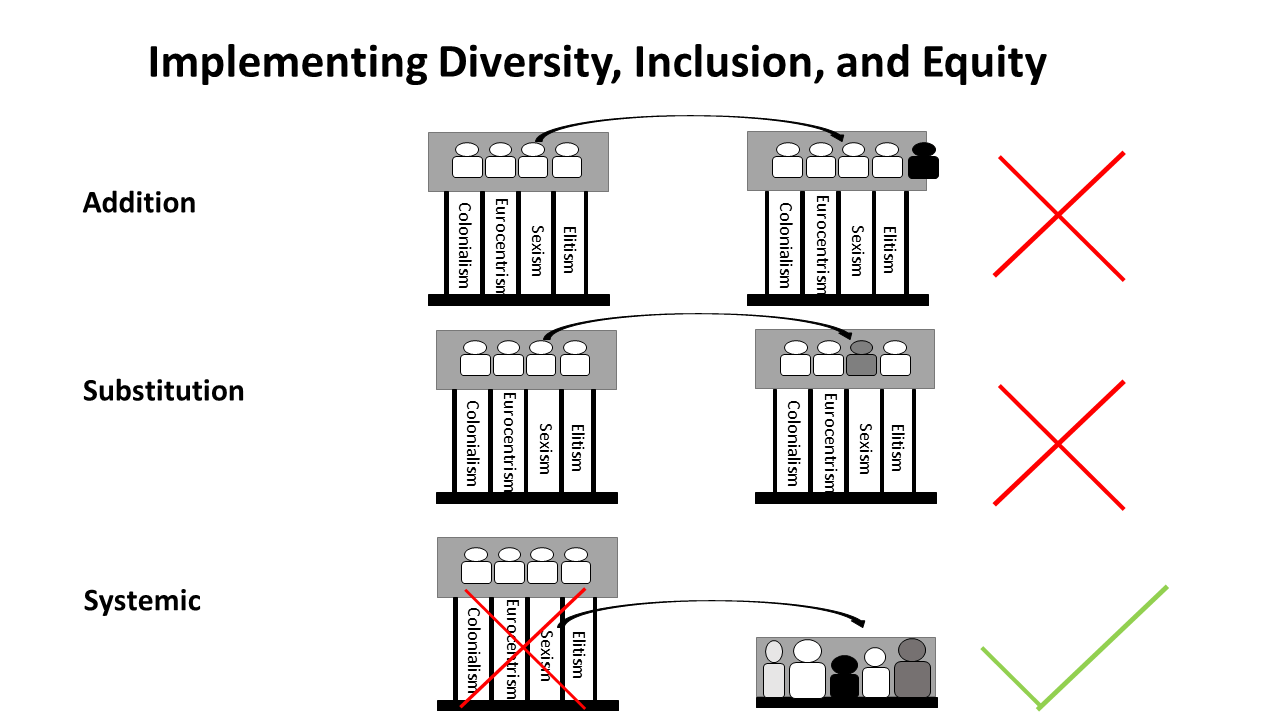
Diversity, Inclusion and Equity can be implemented in a workplace in different ways.
Additive: One is additive, by adding new people and programs in the workplace. In this way, the organization hopes to infuse their existing world with new voices, as like adding spice to a bland meal. This approach has strengths, in that there is more variety being adding to the workplace. But, it puts an unnecessary onus on the marginalized people and programs being added to the institution to “fix” systemic problems.
Subtractive: Many organizations perceive a subtractive approach is more efficacious. For example, when positions come open, they purposeful hire a marginalized person (perhaps also proudly toutly their accomplishment). Unlike the additive method, this approach works under the operating auspices of the organization, i.e. not adding new positions or projects that could be cut eventually. Yet, this approach effectively creates some of the same problems as the additive approach. The marginalized person is still being asked to be the actor of transformation.
Systemic: Diversity and equity initiatives are basically about transforming culture. This requires understanding the many ways that the culture supports inequity and prejudice. Many of these issues are hiding in plain sight, interwoven into all the practices of the institution. Every element of the work of the institution could be imbued with problems. For diversity and inclusion initiatives to truly take hold, the institution needs to examine their practices. Here is where a consultant, or outside voice, can be essential. Just as people are often blind to their own faults, organizations often ignore the largest roadblocks to true diversity.
Systemic change, however, requires a commitment to being honest, thoughtful, and responsive. Unlike the additive and subtractive ways to implement diversity, systemic change is a process-based towards transformation. Processes take time and coordination between people, and ideally, non-hierarchical knowledge-sharing. Seen broadly, systemic change requires a number of steps:
- Grow your team’s ideas and knowledge-base. Organizations, whatever the field, are often siloed knowledge networks. Fields bring people with similar training together, and then they generally partake in similar types of professional development. Change is about fostering difference. So, the staff needs to be able to understand and embrace difference.
- Examine the practices of the organization and attempt to understand facets that support or mask bias. This process will be slow and iterative.
- Rework those elements in a collaborative manner. This type of change needs to blend many (diverse) voices. They need to be diverse in all sort of ways (age, gender, education) in order to create a process that can handle diverse challenges.
- Iterate your new processes. Try out new processes, and then circle back with your teams to see how to improve them. Make sure everyone understands that processes need to grow and adapt so that they are willing to share feedback.