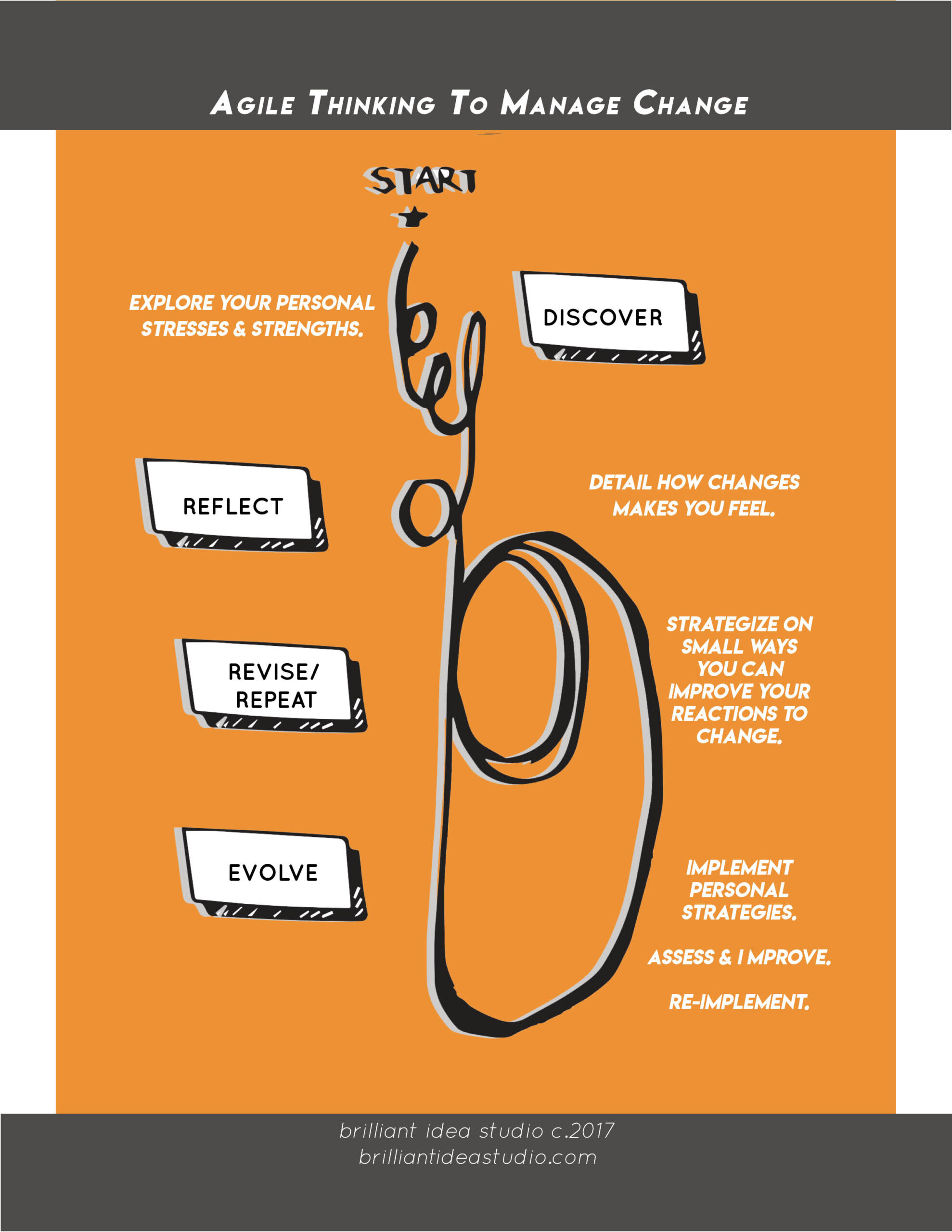
Agile was a buzzword, drawn from software designers who came up with an effective means of developing, testing, iterating, and launching in the most efficient manner.
There are plenty of posts that talk about using Agile (and related iterative processes) for personal development. For me, I find agile particularly useful when thinking about weathering change. The challenge for most of us with change is the uncertainty. You have the feeling of walking backwards on a moving sidewalk; the backwards movement sucks but the concentration on remaining standing is even worse. Keeping a few tips from Agile development in mind can help you feel capable of handling change. You might still be walking backwards, but you will at least know that you will know that you can stand up if you fall.
Discover
Change is unpredictable. But, your reactions are predictable. For example, when someone insults you what will you do? You probably have an experience to recall. What did you do then? There is a 75% chance you will do the same thing. For example, I am a reactor. If you insult me, I will make fun of you. And, then you won’t like me. However, I am also happy to make up and forget it.
So, sit down to be thoughtful about your reactions:
- What issues trigger negative reactions? Are you okay with the result of those negative reactions?
- What really stresses you out related to change? What kinds of change don’t stress you out?
- What types of change seemed doable? Why were those doable?
Most importantly, don’t judge yourself. Just write. Don’t second guess. There is no wrong answer.
Reflect
Go back to your list and annotate your answers. Fill in the feelings associated with each answer. Put your sheet away. Come back to it. Add other ideas that might come to mind.
Revise/ Repeat
- These notes are where you are now. You might even rewrite it as a series of ideal scenarios, like “if X happens, I generally react like y.” These are your current state scenarios.
- Turn your scenarios into goals: If this X happens, I would like to react like y. Those will be your change goals.
- Come up with some tactics to get you from your current action to your change goals. Write down one or two ways that you can act differently. Focus your strategies on yourself. You can only efficiently and effectively change you; everything else is pretty much a moving target.
- Try these strategies.
- Sit down and consider what worked and what didn’t.
- Amend your strategies.
- Try your new strategies.
Let’s go back to our example of my short temper above. Let’s say that I have decided that for 90% of the times I don’t think the negative reaction is worth it. For those 9/10 times I need to find some ways to change myself. So for those I might tweet out my insult. But then, it turns out my network is big enough that the “victim” finds out. The act of writing the insult was satisfying, but the fact that people could read it was not. So, then I decide to write it on paper.
In other words, try a plan. Figure out what is wrong with the plan. Improve the plan.
Evolve
Ideally steps 4-7 above have a short turn around (like in one conversation). But, it takes practice to become so thoughtful about your reactions. So, give yourself a chance to get better.
In the end, tactical action in relation to change is the goal. You start getting more and more strategic about your reactions as you practice. You will eventually get so used to handling yourself during change, that it will be your normal.